Pelvic floor training after birth
MyPelvi shows you how to train and strengthen your pelvic floor after birth to prevent or reduce incontinence.


MyPelvi shows you how to train and strengthen your pelvic floor after birth to prevent or reduce incontinence.
There are many myths and unanswered questions about the pelvic floor after birth. Unfortunately, the topic is still far too often taboo, trivialized, overdramatized or ignored. MyPelvi wants to change that and shows you exactly what happens to your pelvic floor during pregnancy, during birth and afterwards.
During and after pregnancy, your body changes in many ways and your pelvic floor plays a central role in this. It is put under a lot of strain during and after pregnancy and therefore needs special attention and regular training sessions before and a few weeks after birth, for example with MyPelvi.
During pregnancy, the extra weight of the baby puts a lot of strain on your pelvic floor. The extra weight presses on the pelvic floor and gradually stretches it. This supports your organs and the growing baby.
In addition, pregnancy hormones such as relaxin and progesterone ensure that your muscles and ligaments become softer and more flexible - including your pelvic floor. These changes are important for childbirth, but they also weaken your pelvic floor muscles.
The birth itself puts enormous strain on your pelvic floor. Especially during a vaginal birth, it has to stretch extremely to allow your baby to enter the world. Unfortunately, this can have serious consequences that can lead to a longer recovery time. These include:
Three to six months after birth, approximately 1/3 of women suffer from urinary incontinence, 1/10 from fecal incontinence and 1% from prolapse. However, the risk of prolapse increases with each subsequent birth after vaginal birth [4].
However, these consequences vary from person to person and in many cases can be alleviated or even completely eliminated with targeted pelvic floor exercises before and a few weeks after birth. Give your body time to recover and at the same time support it with targeted pelvic floor exercises if your midwife gives the green light:
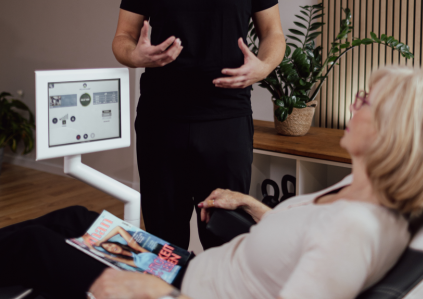
With MyPelvi you have the opportunity to strengthen your pelvic floor muscles using the latest technology. All you have to do is sit down on the MyPelvi chair and lean back. The magnetic wave technology does the work for you, training your pelvic floor very specifically with up to 25.000 muscle contractions:
Learn more about MyPelvi before and after pregnancy
Why is pelvic floor training so important after childbirth? Your pelvic floor is the foundation of your body. A strong pelvic floor supports your organs, prevents incontinence, and improves your posture.
After giving birth, pelvic floor exercises are especially important to strengthen your weakened muscles and relieve possible discomfort such as uncontrolled urine loss or a feeling of discomfort.
In addition to precise instructions, it is crucial that training after birth becomes a permanent part of your everyday life. Ideally, consistent pelvic floor training is already part of your sporting activities before pregnancy [3].
The sooner you start gentle exercise, the better you will support your body in its recovery. It is best to discuss the exact time with your midwife so that you can get fit again quickly and at the same time give your body enough rest.
In the first few weeks after birth, your pelvic floor needs one thing above all else: rest. How long your pelvic floor feels weak after birth depends on many factors, such as the type of birth, your physical condition before pregnancy and whether there were any complications.
As a rule, the pelvic floor is weakest in the first six to eight weeks after birth. During this time, you should avoid heavy lifting and intensive exercise and give it plenty of rest.
You can often do light pelvic floor exercises just a few days after giving birth - ideally in consultation with your midwife or doctor. It's not about training your pelvic floor intensively right away, but rather slowly becoming aware of it again and promoting blood circulation.
Give yourself and your pelvic floor at least six weeks of rest before you start any targeted training. Gentle postnatal exercises or walks are recommended in the phase immediately after birth.
After six to eight weeks, you can specifically support your pelvic floor with MyPelvi's pelvic floor training. The best part? You don't have to exert yourself for this training, you can just sit back in your everyday clothes for 22 minutes:
The longer you wait to start pelvic floor exercises, the more difficult it can be to fully strengthen your pelvic floor again. Although it is theoretically never too late to start training, the effort becomes greater over time and it requires more discipline and patience to achieve noticeable results.
If the pelvic floor is neglected for too long, consequences such as persistent incontinence or even organ prolapse can occur, which are often more difficult to correct.
So start early to support your body after birth with pelvic floor exercises from MyPelvi.
It is important that you seek support for your pelvic floor training after the birth, no matter how "fit" you were before. Your expert can then ensure that your pelvic floor, abdominal and back muscles work together functionally and help you strengthen your core.
You should pay particular attention to the following special feature in the first weeks of training:
If you notice any abnormalities, seek medical or therapeutic advice or consult your midwife.
You can find more information about MyPelvi training here
When the body feels “normal” again after giving birth, injuries have healed and the muscles regain their tone, varies greatly from person to person. For some women, the pelvic floor feels “normal” again after just three to six months, while for others it can take up to a year or longer.
It is important that you listen to your body and give it the time it needs. With regular training, such as the pelvic floor training from MyPelvi, and enough patience, you will notice how your pelvic floor gradually recovers.
Your pelvic floor is subjected to enormous stress during and after pregnancy. But the good news is: with targeted pelvic floor training, you can do a lot to make it feel stronger again and to make you feel good in your body. It's never too late to start - whether six to eight weeks after the birth or months later. Your pelvic floor will thank you!
1) https://www.thieme-connect.com/products/ejournals/html/10.1055/a-1020-5883
2) https://link.springer.com/article/10.1007/s41972-022-00168-8
3) https://link.springer.com/article/10.1007/s41906-017-0201-2
4) https://econtent.hogrefe.com/doi/abs/10.1024/0040-5930/a000003?journalCode=tum