Pelvic floor training against incontinence: How to get your bladder under control
Learn how MyPelvi's pelvic floor exercises can help you regain control.


Learn how MyPelvi's pelvic floor exercises can help you regain control.
You know that feeling? You sneeze, laugh, or jump, or you suddenly feel the urgent need to go to the bathroom – and then it happens... Involuntary urine loss can be extremely unpleasant, and many sufferers feel embarrassed and socially restricted. But the good news: You can actively do something about it! Learn how MyPelvi's pelvic floor exercises can help you regain control.
Have you already researched options for incontinence and all you've found are incontinence pads or Kegel exercises? Don't worry, MyPelvi won't leave you alone with your incontinence. We know how uncomfortable and restricted your life can feel when your bladder isn't functioning the way you'd like.
Imagine the pelvic floor like an elastic trampoline – it supports the organs in the pelvic cavity and ensures that your bladder and bowel only empty their contents when you consciously want them to. When these muscles are weakened, meaning the trampoline has lost its elasticity – whether due to pregnancy, hormonal changes, excess weight, or simply a lack of exercise – they can no longer optimally fulfill their supporting and closing function.
This means that even everyday movements such as coughing, laughing or jumping can lead to involuntary loss of urine or the bladder can send overactive signals even though it is not full.
But there are ways to actively take action: Pelvic floor training with MyPelvi uses targeted magnetic stimulation to target the deeper muscle layers of the pelvic floor – including those that support urethral closure. Many of our clients report that the training helps them strengthen their muscle network and become more aware of the activation of the pelvic floor. This can make it easier to respond to stressful situations in everyday life, such as sneezing or laughing. MyPelvi's pelvic floor training offers the following benefits:
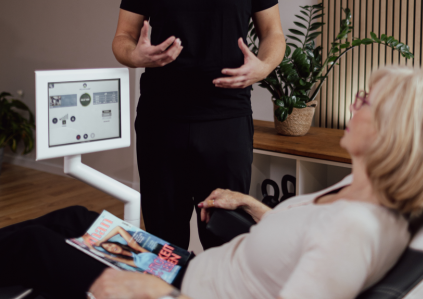
The best part: MyPelvi pelvic floor training is easy to integrate into your daily routine, as each session lasts only 22 minutes. The innovative magnetic wave technology reaches the deepest layers of your pelvic floor, which are difficult to reach with conventional exercises. Take a seat, lean back, and feel the first results in just a few weeks:
Secure your non-binding trial session now
MyPelvi Extra Tips: There are also a few things that can help you regain bladder control. These include:
Pelvic floor training with MyPelvi is a simple yet highly effective method for improving incontinence. However, not every type of bladder weakness has the same cause – and training isn't always the only solution. It's crucial to know the specific type of incontinence and understand when targeted pelvic floor training can help.
Don't worry, our MyPelvi experts will work with you to determine what type of incontinence you might be experiencing in a free, discreet, and secure session.
Secure your non-binding trial session now
1) Stress incontinence
This is the most common form in women, for example, during menopause or during and after pregnancy. It occurs when urine is released involuntarily when coughing, sneezing, laughing, or jumping. The reason: the pelvic floor is too weak to withstand the sudden pressure. Through targeted training, the muscles can be strengthened so that they can better fulfill their supporting function.
2) Urge incontinence (overactive bladder)
Here, the bladder constantly tells you "I have to go!" even though it's not full yet. This is often caused by overactive bladder muscles or a disruption in the signal transmission between the bladder and the brain. A trained pelvic floor can help improve bladder function and delay the urge to urinate.
3) Mixed incontinence
This form combines stress and urge incontinence. Pelvic floor exercises can be helpful in both cases, as they strengthen the muscles while simultaneously improving awareness of bladder function.
If nerves are damaged—for example, due to diseases such as multiple sclerosis, a stroke, or severe complications of diabetes—bladder control can be impaired. In these cases, pelvic floor exercises alone are usually not enough because the problem lies not in the muscles but in the signal transmission between the brain and the bladder.
In this case, the bladder doesn't empty properly and instead overflows. The cause can be a narrowing of the urethra, weakened bladder muscles, or a neurological disorder. Pelvic floor exercises are only of limited help in these cases, as the problem often lies elsewhere and may require medical treatment.
If there is a direct connection between the bladder and other organs, such as the vagina or bowel, urine can leak uncontrollably. Such malformations or injuries, such as those following a difficult birth, can usually only be corrected surgically. Be sure to seek medical advice.
Targeted pelvic floor training can be an important building block for better dealing with bladder weakness – but it requires patience and the right method. Pelvic floor training isn't a miracle cure that works overnight, but it can bring significant long-term improvements. Moreover, many people think they just need to "tighten up down there" – but the pelvic floor is a complex network of muscles that work in conjunction with the abdominal and back muscles.
With MyPelvi, you have the opportunity to support your pelvic floor particularly effectively and reach even the deepest muscle layers effortlessly. The magnetic waves can penetrate up to 15 cm into your body and trigger contractions in muscles you didn't even know you had. Try it out and book your MyPelvi trial session:
Secure your non-binding trial session now
Bladder weakness isn't an inevitable fate—you can actively take action! With regular pelvic floor exercises from MyPelvi, you can strengthen your core. Many report that after a few weeks they noticed a better body feeling in everyday life. Completely effortless on your part, because the magnetic waves penetrate deep into your muscles, training them with pinpoint accuracy. So, what are you waiting for? Your pelvic floor will thank you!