How to prepare for your skiing holiday
MyPelvi explains why the pelvic floor plays a key role on the slopes and what you absolutely need to consider after childbirth.
Katharina Heilen · 22 January 2026
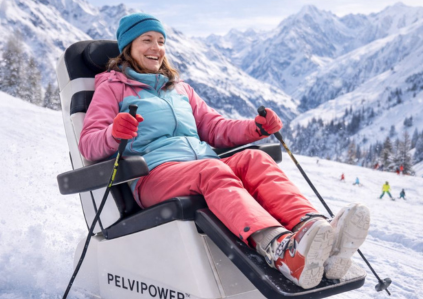
Skiing means fresh mountain air, fun … and hard-working leg muscles. But what many people do not know is that skiing also places intense demands on the pelvic floor. Whether when turning downhill, braking suddenly or adopting the typical crouched position. The pelvic floor stabilises, cushions pressure and provides control. If it is overloaded or not sufficiently trained, this may manifest itself in instability, a feeling of insecurity or urine leakage under strain, among other things.
MyPelvi explains why the pelvic floor plays a key role on the slopes, how to prepare specifically for a skiing holiday and which particular points you must consider after childbirth.
The invisible work your body does on the slopes
Skiing is far more than an enjoyable descent: It is a highly complex interaction of muscle work, balance, coordination and inner stability. And this is exactly where the pelvic floor comes into play. The following areas of the body work intensively together when skiing:
Lower limbs: The thighs, buttocks and calf muscles bear the main load. They provide power, cushioning and movement control. Torso & core muscles: The deep abdominal and back muscles stabilise the upper body, help with balance and protect the spine. Balance system: Proprioceptive stimuli (i.e. the ability to perceive the body's position in space) are constantly trained by the changing terrain on the slopes. Breathing & posture: Stable posture is particularly important due to dynamic movements and changing pressure. This is exactly where it gets interesting: As part of the deep core muscles, the pelvic floor is directly involved.
The pelvic floor while skiing? Oh yes!
The pelvic floor consists of several muscle layers that stretch like a hammock between the pubic bone, coccyx (tailbone), and sit bones. When skiing, it has several functions:
1. Shock absorber & pressure manager
When jumping, landing after uneven terrain, or in deep leg positions (e.g., squatting), significant pressure is exerted on the pelvic floor. It absorbs these pressure spikes and helps relieve the bladder, bowels, and organs under stress.
2. Stabilizer in the core team
Together with the abdominal muscles, diaphragm and back muscles, the pelvic floor provides deep core stability. This “inner unit” ensures that you do not wobble like a snowman on the slopes, but ski with control, precision and efficient use of your strength.
3. Reflex muscle
The pelvic floor is not designed to be ‘permanently contracted’. Rather, it must quickly react to pressure, adapt, and relax. Its reactive function is particularly crucial in sudden movements such as quick swings or direction changes.
This is precisely where training with the MyPelvi pelvic floor chair comes in: It helps you not only activate the muscles, but above all perceive them in a targeted way and support their natural responsiveness. Thanks to its innovative magnetic wave technology, it can do so even without any effort on your part:
Ready to begin?Book a no-obligation MyPelvi trial session now
How to recognise that your pelvic floor is under too much strain
Many people only notice that something is not right when skiing. Signs may include:
slight urine loss when skiing downhill or sneezing on the slopes a feeling of pressure in the pelvic floor area back tension caused by a lack of core stability a feeling of an “unstable base” during exertion
A well-trained pelvic floor means
can have a stabilising effect during physical exertion and improve body awareness. better body control on varied terrain more stable posture when tired
Before hitting the snow: What your body needs now
Your next skiing holiday is just around the corner, but instead of simply throwing yourself into your gear, it is worth preparing your body in a targeted way. Not only to avoid sore muscles, but also to improve your technique, prevent injuries and feel completely safe and strong on your skis.
Pelvic floor training with a system: MyPelvi for preparation
One key that is often underestimated: the pelvic floor. To function optimally under strain, it needs targeted training, and this is precisely where the MyPelvi pelvic floor chair comes in.
Using magnetic waves, MyPelvi activates the deep pelvic floor muscles without any effort on your part. The impulses promote the responsiveness of the muscles, can support muscle awareness and control, and assist their interaction with the torso and core muscles.
Particularly useful if you have little time:
Ready to begin?Book a no-obligation MyPelvi trial session now
Just become a mum? What you should know before skiing
Giving birth is one of the greatest physical achievements the female body can accomplish, whether vaginally or by caesarean section. And no matter how much you long for movement, freedom and a sense of normality, skiing is not an activity you should simply resume straight away. Especially not if the pelvic floor is still undergoing postnatal recovery.
Why skiing after giving birth can be risky
Skiing is a sport that places high demands on the entire body, and particularly on the pelvic floor and core stability. After childbirth, these are precisely the areas that are often weakened or even injured. The greatest risks are:
Pelvic floor overload due to pressure and impact (e.g. when jumping or in a deep skiing crouch) Incontinence due to inadequate muscle control Back pain if the deep core muscles have not yet regained stability Ligament weakness due to hormonal changes (relaxin can continue to have an effect for up to 6 months) Risk of falling if balance and reactions are still impaired
How soon can you return to the slopes?
Returning to skiing after childbirth depends heavily on your individual healing progress, but general guidelines can help provide orientation:
After a spontaneous, uncomplicated birth
No earlier than 3 months after giving birth Prerequisites: completed postnatal recovery, good general health and a gradual training programme that protects the pelvic floor
After a caesarean section or in the event of complications
At least 4–6 months, depending on healing Caution: Even if your abdomen feels fine, the deep muscles are often not yet resilient enough
For persistent symptoms (e.g., incontinence, sinking feeling, pain)
medical or physiotherapy assessment beforehand is essential no skiing until stability and control have been restored
Skiing after childbirth? Yes, but not too soon, not without training and not without taking your body's needs into account. After childbirth, the pelvic floor needs time, attention and targeted training before it can cope with the demands of the slopes.
With good preparation, a safe, gradual build-up and your doctor's approval, you can soon ski down the slopes safely and enjoyably again.
Ready to begin?Book a no-obligation MyPelvi trial session now
Conclusion: Strong on the slopes with core training
Skiing is more than just fun in the snow; it is a real challenge for your whole body. If you begin your skiing holiday well prepared, you will not only ski more safely, but also more comfortably. And right at the centre of it all is your pelvic floor. It works in the background, stabilising, protecting and responding. Provided you have not forgotten it in your training. Whether you want to return to skiing after childbirth or simply feel that things “down there” deserve more attention, a consciously trained pelvic floor makes a difference to control, body awareness and self-confidence. The key: timely preparation, targeted training and smart tools such as the MyPelvi pelvic floor chair, which can help you activate your core and prepare for your skiing holiday.
Ready for your trial session?
Learn the right technique with guidance — free of charge at your MyPelvi studio.