Improve your posture: your guide
Find out how you can improve your posture today and thereby have a major impact on your quality of life.
Katharina Heilen · 9 September 2024
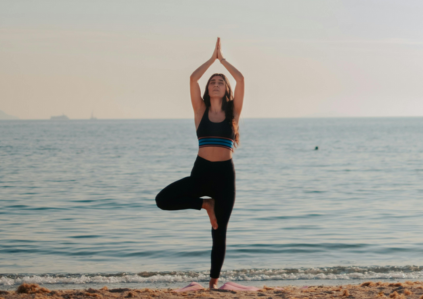
Do you sit hunched over your computer or steering wheel? Do you feel tense? Good posture is more than just “nice to have”. Good posture is a must-have when it comes to your long-term health and well-being. In this article, you will learn how to improve your posture today and make a major difference to your quality of life. We reveal some surprising facts!
Why is good posture so important?
There are many reasons why good posture is so important.
Optimal posture:
- Relieves pressure on our joints and reduces incorrect loading. - Promotes efficient breathing and circulation. - Prevents muscle tension. - Helps prevent pelvic floor pain.
Maintaining poor posture over the long term harms not only the body and well-being, but also self-perception.
Posture & self-evaluation
The concept of self-validation examined in one study states that our posture is closely linked to our thoughts and feelings. Researchers found that people's self-perception changed when they wrote down their thoughts in a confident posture (upright with the chest raised) or a doubtful posture (leaning forwards with the back hunched).
Although a confident posture did not affect the number or quality of thoughts, it did influence how certain participants felt about their own thoughts – whether positive or negative. An upright, confident posture can strengthen trust in one's own thoughts and thus have a positive influence on self-evaluation or self-validation. Put simply: you trust yourself more when you hold your body upright [1].
Which muscles are involved in posture?
Most people think that the back alone influences your posture. But contrary to what you might think, your posture is maintained and stabilised through a complex interplay of different muscle groups.
The most important include:
- Back muscles: They support the spine and keep you upright. The deep muscles along the spine are particularly responsible for stability. - Abdominal muscles: A strong core supports the back and provides a stable centre, which is essential for an upright posture. - Pelvic floor muscles: Often underestimated, but very important! The pelvic floor connects the lower half of the body to the torso and contributes to the stability and alignment of your pelvis.
If your pelvic floor is weakened, this can not only negatively affect your posture but also contribute to incontinence and loss of libido. MyPelvi training gives you a unique opportunity to strengthen your pelvic floor in short training sessions of just 22 minutes.
Magnetic waves stimulate and strengthen the deep muscles. With no physical effort at all! All you have to do is sit down on the MyPelvi chair, lean back and experience the effect for yourself:
Ready to begin?Book your MyPelvi trial training now
- Neck and shoulder muscles: These muscles keep your head in a neutral, upright position. They stop your shoulders from rolling forward and your head from tilting forward. - Glute and hip muscles: They support the position of your pelvis and hips and influence the alignment of your entire spine.
A balanced training routine that addresses all these muscle groups can improve your posture in the long term.
What constitutes good posture?
Good posture is characterised by a gentle S-curve in the spine. It looks like this:
Optimal posture when standing
Your shoulders should be relaxed and drawn back, your chest slightly forwards, your head in a straight line with your back and your chin parallel to the floor. Your weight should be distributed evenly across both feet, with your knees slightly bent.
Optimal posture while sitting
When sitting, your feet should be flat on the floor, your knees at right angles and your back fully supported by the backrest. The shoulders should remain relaxed and pulled back while the head is pointed straight forward. The neck is neither bent forward nor overextended.
These postures help prevent tension and strain in the muscles and joints and promote healthy function throughout the musculoskeletal system.
Can poor posture be corrected?
Yes, absolutely!
Studies show that, regardless of age, you can correct unhealthy posture or muscular imbalances through targeted training. The most effective way to improve your posture is to focus on the pelvic floor, core, abdominal and lower back muscles that support your spine and pelvis [2].
Which exercises help improve posture?
A holistic training approach is crucial for effectively improving posture. Here are some recommendations:
Pelvic floor training
Your pelvic floor plays a crucial role in the stability of your entire body. The revolutionary 22-minute magnetic field stimulation training on the MyPelvi chair allows you to train your pelvic floor without effort, sweating or special clothing. This training reaches the deepest muscle layers and provides stability for the pelvic floor, core, and lower back. It is particularly practical and effective for those who want to improve their posture despite a stressful daily life.
Back training
Strong back muscles are essential for healthy, upright posture. Exercises such as the “Superman”, where you lie flat on the floor and repeatedly raise your arms and legs slightly, or rowing help strengthen the back muscles in a targeted way.
Core Training
Core exercises are exercises that strengthen the centre of the body and the core muscles, namely the abdomen, hips, pelvis and lower back. Exercises such as forearm planks, press-ups with a diagonal leg drive and sit-ups particularly strengthen the abdominal muscles and help support the spine.
Shoulder and neck exercises
Stretching and strengthening exercises such as shoulder rolls or arm circles are very helpful for relieving tension in the shoulder and neck area and keeping the shoulders in the correct position. These exercises help increase flexibility and strength in this area. This in turn promotes healthy posture and helps prevent pain.
Mobilisation exercises
Yoga and stretching are excellent ways to improve flexibility and reduce restrictions in movement. Although these exercises do not contribute significantly to muscle strengthening, they support your overall mobility, relieve tension and keep your joints healthy. Choose this exercise as an effective and beneficial complement to the strength exercises.
How long does it take to improve your posture?
How long it takes for visible and noticeable improvements in your posture to appear depends on your starting point and how regularly you train.
- Initial changes: After just a few weeks of regular training and conscious posture correction, you may notice initial changes and a stronger feeling from within. - Medium-term changes: After a few more weeks, you will notice that you have to make less effort to maintain an upright posture because your muscles have become stronger. You will be able to see a clear improvement. - Long-term improvements: If you want to establish new, long-term posture habits, this can take several months. Sounds like a long time? Do not worry, because it is worth it! Studies have found that regular training can prevent long-term musculoskeletal problems [4].
Remain patient and consistent! Speak to one of our MyPelvi experts and receive a personalised training plan tailored to your individual needs so that you can notice initial results soon:
Ready to begin?Book your trial training and consultation now
Practical tips for better posture in everyday life
We know how quickly you can fall back into old posture patterns. You sit at your desk with your shoulders rolled forwards, scroll through your phone with your head tilted down (caught you?) or stand at the cooker with your pelvis tilted forwards.
We know these poor postures all too well ourselves, which is why we have gathered some practical tips to help you pay more attention to your posture in everyday life too.
- Adopt a conscious posture: Stick a note on your screen or set a reminder on your smartphone. These should remind you to keep your back straight when sitting and standing, let your shoulders relax back and down, and tuck your chin in slightly. - Ergonomic workspace: Are your desk and chair adjusted optimally? You should be able to place your feet flat on the floor while your legs form a right angle. The armrests should be level with your desk, and your arms should also form a right angle. - Regular breaks: Around one fifth (!) of adults in Germany sit for at least four hours a day and do no physical activity in their leisure time [3]. It is no wonder that our posture suffers as a result.
Our tip: During long periods of sitting, stand up regularly, move around and do some gentle stretches. For example, stretch your arms into the air, bend forwards with your knees slightly bent or rotate your torso a few times. - Pay attention to your breathing: Do you breathe deeply into your abdomen or more shallowly into your lungs? Deep, conscious abdominal breathing contributes to an upright posture and helps the muscles relax. - Posture correctors: Are aids such as posture correctors or back supports effective? They can remind you in the short term to pull your shoulders back and keep your spine upright. This can be particularly useful in cases of chronic postural weakness or long periods of desk work.
However, these posture correctors should only be regarded as a supportive measure, not a permanent solution. In the long term, it is important to strengthen the muscles responsible for good posture through targeted exercises.
An upright posture helps you remain mobile for a long time and helps keep your muscles and joints free from pain. Your posture can also play a significant role in how confident you are in your thoughts. You could say: the more upright you stand and sit, the more you believe what you think. This is particularly beneficial if you want to reinforce your positive thoughts.
Choose a form of training, such as pelvic floor training from MyPelvi, that feels easy and integrates well into your everyday life. This will help you keep going, and you may soon notice the first changes in your posture. Take the first step today, let experts guide you and feel the difference that good posture can make in your life!
References
- 1) https://onlinelibrary.wiley.com/doi/abs/10.1002/ejsp.607
- 2) https://openurl.ebsco.com/EPDB%3Agcd%3A10%3A9826426/detailv2?sid=ebsco%3Aplink%3Ascholar&id=ebsco%3Agcd%3A132493400&crl=c
- 3) https://edoc.rki.de/bitstream/handle/176904/10233/JHealthMonit_2022_03_Sitzzeiten_GEDA_2019_2020.pdf
- 4) https://content.iospress.com/articles/journal-of-back-and-musculoskeletal-rehabilitation/bmr181196
Ready for your trial session?
Learn the right technique with guidance — free of charge at your MyPelvi studio.