When your bladder suddenly stops cooperating: bladder weakness after childbirth
Postpartal stress incontinence is common, but hardly anyone talks about it. But MyPelvi shows you solutions!
Katharina Heilen · 17 June 2026
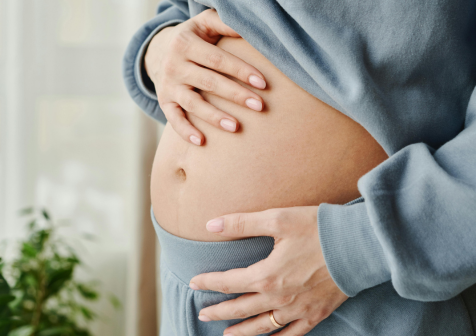
Baby's here, happiness complete? Not quite. Many new moms know the feeling: you sneeze, laugh, or jump, and — oops — it leaks. Bladder weakness after birth is common, but hardly anyone talks about it. Yet there are solutions! In this article, MyPelvi explains why bladder weakness happens after giving birth, how long it tends to last, and what you can actually do about it.
Why does my pelvic floor feel pressured after childbirth?
Unfortunately, this uncomfortable sensation of pressure in the pelvic area is not uncommon after childbirth. Many women describe it as “heavy”, “descending” or “like the sensation of a foreign body”. And no, you are not imagining it! Your pelvic floor has been through a great deal during pregnancy and childbirth and is now asking for a break.
Typical reasons for the sensation of pressure include:
- Overstretching of the pelvic floor muscles due to the baby's weight and childbirth - Weakening of your connective tissue, especially during hormonal changes such as the drop in oestrogen after childbirth. - Displacement or prolapse of organs, such as the bladder or uterus. - Injuries or microtrauma, e.g. due to a perineal tear or forceps delivery. - Physical strain too soon after childbirth, e.g. heavy lifting or too much activity.
The sensation of pressure after childbirth is usually temporary, but it is also a sign that your pelvic floor needs time to heal. Remember: You do not have to get back to normal immediately, and you should give yourself time to recover.
If the sensation of pressure has still not subsided after several weeks, your pelvic floor may need support. MyPelvi is here for you: its 22-minute pelvic floor training allows you to do something good for yourself even as a busy mum. The best part? You do not even have to exert yourself and can lean back during the training:
Ready to begin?Book your MyPelvi trial training session now
How long does bladder weakness last after childbirth?
First, the good news: in many cases, bladder weakness after childbirth is temporary. The bad news is that it often lasts longer than you might think, and many mums ignore it because “it's just part of it”. But it doesn't have to be. Bladder control usually returns to normal on its own within the first 6 to 12 weeks after childbirth. It is important not to overtax your body and to give your pelvic floor time. Anyone who resumes activity too quickly (e.g. jogging, trampolining, carrying heavy shopping…) risks the symptoms persisting or worsening.
During the first days to weeks after childbirth
Many women notice that they leak urine when coughing, sneezing or laughing. This is because the pelvic floor is soft, weakened and overstrained.
Around 6–12 weeks after childbirth
Most often, control improves noticeably if you are careful and gently start activating your pelvic floor muscles again.
A few months after giving birth
If you train your pelvic floor regularly, everything can return completely to normal. The most effective training for bladder weakness after childbirth is MyPelvi pelvic floor training. The state-of-the-art magnetic wave technology reaches even the deepest layers of your pelvic floor. This strengthens your pelvic floor comprehensively and helps you regain full control over your bladder soon.
In short, it is completely normal not to have full control over your bladder initially after childbirth. Even a year after childbirth, it is not unusual if everything does not yet feel as it did before.
But be careful: birth injuries should not be underestimated. Studies show that the pelvic floor muscles and bladder can still be affected by vaginal births and forceps deliveries in particular almost a decade after childbirth if the symptoms are not addressed[1].
How long bladder weakness lasts after childbirth varies from woman to woman. It depends entirely on how the birth went, how quickly your pelvic floor recovers and how much rest and support you allow yourself.
How long does it take for the bladder to heal after giving birth?
After childbirth, the bladder is often a little out of sync. During pregnancy, it was compressed by the growing baby and may even have sustained a few knocks during birth, especially if the birth was long or particularly intense. An epidural or catheter can also affect your bladder function.
In most cases, everything returns to normal within the first few weeks after childbirth. Your body begins healing immediately after the birth. How quickly this happens depends on many factors: your individual predisposition, the course of the birth, hormonal changes and, above all, how much rest you really get during the postnatal period.
If you still have symptoms after six to eight weeks, such as an unusual sensation when urinating, an irregular urge to urinate or uncertainty about being able to hold urine, there is no need to panic. It is a sign that your body still needs support. Trust your instincts and seek advice from our MyPelvi experts if you notice that nothing is changing. You do not have to wait until it gets worse:
Ready to begin?Book your MyPelvi trial training session now
What should you do if you cannot urinate after childbirth?
As strange as it may sound, some women are in fact unable to go to the toilet after childbirth even though their bladder is full. This is called urinary retention and can be very uncomfortable. You feel pressure or pain in your lower abdomen, but nothing comes out, or only a few drops. Don't panic: it happens more often than you might think, especially after an epidural, an episiotomy or a very quick birth.
It is important not to ignore this. Tell your midwife or the hospital staff immediately. A temporary catheter is often needed to empty the bladder and relieve the pressure. This is nothing dramatic and generally does not hurt, but it allows your body to relax and recover.
How long urinary retention lasts varies. For most women, bladder function returns to normal within a few days to two weeks. Sometimes it takes a little longer for the urge to urinate to become reliably noticeable again or for urination to work without any problems. Patience is required during this time, and sometimes a little support in the form of pelvic floor training with MyPelvi. MyPelvi pelvic floor training strengthens your pelvic floor muscles from within:
Ready to begin?Book your MyPelvi trial training session now
Why the postnatal recovery period is not a myth (and what happens if you ignore it)
The postpartum period is not a romantic “coffee-in-bed-with-the-baby” fairy tale; it’s a recovery room. Your body has just accomplished a lot: nine months of pregnancy, birth (regardless of how it went), perhaps even a small intervention, some birth injuries, and now you’re expected to be fully fit and able to handle stress almost immediately? That doesn’t work that way.
If you don’t give your body the necessary rest during the postpartum period, there can be consequences. Not just because you are tired, but because your pelvic floor, bladder, connective tissue, and hormones are still in an exceptional state. Those who overdo it too soon (e.g., by lifting heavy objects, going for a walk, cleaning up, or even exercising) risk:
- delayed postnatal recovery - ongoing urinary incontinence - prolapse issues - or even long-term pelvic floor problems
The postpartum period is not weakness; it’s self-care. You should rest, get help, and take your time to adjust to your new life as a mother. Not just for the baby, but especially for yourself.
Caution in cases of bladder enlargement
In pregnant women with bladder enlargement (bladder augmentation), there is an increased risk of urinary tract infections. Therefore, it can be sensible to take preventive antibiotics. The birth should be planned by specialists from different fields, such as gynecology and urology. If medical reasons exist, a scheduled cesarean section with the presence of a urologist may be the best solution for many women. In some cases, a vaginal birth can also be an option.
Conclusion: you are not alone and you can do something!
Bladder weakness after birth is not a taboo topic. It's common, normal, and treatable. The most important step? Talking about it. And the second step? Seeking gentle pelvic floor training support. Your body is strong, and with the right guidance, your pelvic floor will soon be back in shape.
Ready for your trial session?
Learn the right technique with guidance — free of charge at your MyPelvi studio.