Your pelvis in motion: The importance of pelvic tilt
Learn from MyPelvi what role the pelvis plays in posture, mobility, and the well-being of your back.

Learn from MyPelvi what role the pelvis plays in posture, mobility, and the well-being of your back.
Have you ever heard of pelvic tilt? If your pelvis isn't optimally aligned, it's also referred to as pelvic tilt. This can lead to tension, back pain, or pelvic floor problems. Learn from MyPelvi what role the pelvis plays in posture, mobility, and the well-being of your back.
The pelvis is constantly moving—when walking, running, sitting, or standing. But not every movement is beneficial. An unfavorable pelvic tilt can cause discomfort, especially when muscle imbalances or poor posture are present. Did you know that a pelvic tilt even tends to affect the alignment of the head and other parts of the body? [1] Below you will learn about the situations in which a pelvic tilt is referred to:
The pelvis tilts slightly forward or backward with every movement. This natural dynamic helps balance stress and stabilize posture and has no negative effects on your pelvic floor.
If certain muscles are too weak or shortened, the pelvis can end up in an unfavorable position:
Many people spend most of their day sitting. This often causes the pelvis to tilt backward unconsciously, causing the spine to curve unnaturally. This can lead to tension, back pain, and weakened core muscles.
One-sided strain, leg length discrepancies, or scoliosis (a curvature of the spine) can cause your pelvis to be permanently tilted or misaligned. This can result in pain in your lower back, hips, or knees.
The position of the pelvis influences the entire body's posture, especially the spine, hips, and pelvic floor muscles. A forward tilted position increases the hollow back and activates the lower back muscles, while stretching the abdomen. A backward tilted position relieves pressure on the lower back in the short term, but can lead to tension in the long term.
Unconscious or unfavorable pelvic tilting often results from muscular imbalances, weak core muscles, or a lack of exercise. However, a functioning pelvic floor is crucial for targeted stabilization and mobilization of your pelvis.
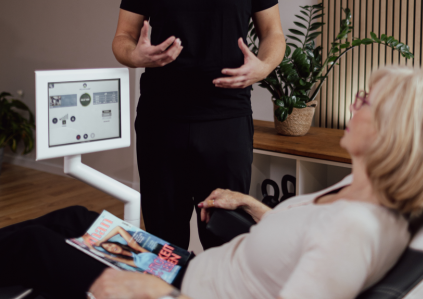
MyPelvi training offers an innovative solution. Using state-of-the-art magnetic wave technology, the pelvic floor muscles are activated down to their deepest layers. In just 22 minutes per session, the muscles contract up to 25.000 times. Many people find this impulse intense and can strengthen awareness of the core.
Effective training that can be easily integrated into everyday life:
Secure your non-binding MyPelvi trial session now
A study shows how common pelvic tilt is among healthy people. The results are fascinating:
The results show that only a few people have an optimally aligned pelvis, and almost all people exhibit pelvic tilt. Ventral pelvic tilt is more common.
You can check for pelvic tilt yourself based on certain postures and symptoms, or have it professionally analyzed. Here are some options:
Stand barefoot in front of a mirror and pay attention to the following points:
While standing or sitting, consciously try tilting your pelvis forward (swayback) and backward (rounded back). If you find a movement particularly restricted or unfamiliar, this could indicate an unfavorable pelvic position.
If you want to improve your pelvic posture, targeted training may be helpful. Pelvic floor exercises with the MyPelvi pelvic floor trainer can help you specifically activate the muscles in the pelvic area and improve your posture. In a free consultation with our pelvic floor experts, you can discuss your posture awareness with them:
Secure your non-binding MyPelvi trial session now
No, pelvic tilt is not the same as pelvic asymmetry, but both can be related:
In short: Pelvic tilt is a movement or postural tendency of the pelvis, while pelvic asymmetry describes a permanent, often structural misalignment of the pelvis.
People with sedentary jobs, in particular, often develop pelvic misalignment—whether it's a pronounced hollow back or a posteriorly tilted pelvis, leading to a hunchback. Both of these poor postures can cause back pain, hip problems, and limited mobility. In addition, the position of the pelvis directly influences the function of the pelvic floor. An unfavorable tilt can lead to over- or under-tension of the pelvic floor muscles, which can affect the bladder, bowel, and overall well-being.
But what should you do if you notice a pelvic tilt? A study has shown that even surgery makes no difference and that implants may be necessary to correct a pelvic tilt [2].
Surgery is often unnecessary. It's often much easier to correct a pelvic tilt naturally. Regular pelvic floor exercises can help strengthen the back muscles and deep core muscles, mobilize the hip joints, and activate the pelvic floor. Those who pay careful attention to a healthy pelvic position can benefit from increased stability, flexibility, and well-being in the long term.
The MyPelvi pelvic floor trainer can provide additional supportThrough targeted impulses, it stimulates the pelvic floor muscles and is found by many to be helpful in improving posture. Completely effortless and in every situation.
Secure your non-binding MyPelvi trial session now
One of the simplest methods to mobilize the pelvis is the pelvic tilt while sitting. You can perform this exercise at home and supplement it with MyPelvi's pelvic floor training.
For even more targeted support, we recommend the MyPelvi pelvic floor trainer. It specifically strengthens the pelvic floor muscles and is found by many to be helpful in improving posture. Ideal for anyone who wants to improve their posture and prevent discomfort.
Secure your non-binding MyPelvi trial session now
Pelvic tilt describes the position or misalignment of your pelvis, as well as a simple yet effective method for mobilizing your pelvis. Just a few minutes of conscious movement per day can make a noticeable difference.
For even better results: Try the MyPelvi pelvic floor trainer and experience how effortlessly you can strengthen your muscles.
1)https://academic.oup.com/ptj/article-abstract/64/4/510/2727727?login=false
2)https://www.sciencedirect.com/science/article/abs/pii/S088354031400789X
3)https://www.sciencedirect.com/science/article/abs/pii/S1356689X11000816