The pelvic floor muscles: invisible & often underestimated
Discover with MyPelvi why pelvic floor training is worthwhile and the best way to approach it.
Katharina Heilen · 9 November 2024
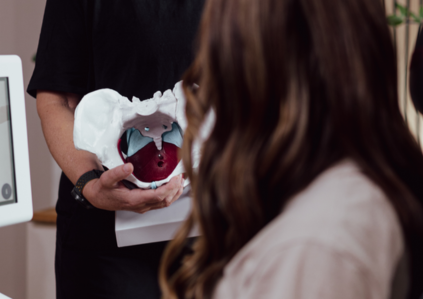
The pelvic floor – a topic we often only think about when problems arise. Yet this invisible muscle group plays such an important role in our daily lives, whether we notice it or not. Whether for incontinence, postnatal recovery, prostatectomy or simply for greater quality of life, performance and sexual fulfilment! Join us to find out why pelvic floor training is worthwhile and the best way to approach it.
What makes up the pelvic floor muscles?
It is useful to divide the anatomy of the pelvic floor into passive and active structures.
The anatomy responsible for the passive structure of the pelvic floor comprises the pelvic bones and connective tissue. Important anchoring points for the pelvic floor muscles and connective tissue are the pubic ramus, ischial spines and sacrum.
The active structure of the pelvic floor is based on the muscle layers [3]. The pelvic floor muscles consist of several muscles that can be divided into three main layers. They are located between the pubic bone at the front and the coccyx at the back and stabilise the bladder, uterus and bowel, among other structures [1]:
1. Diaphragma pelvis (deep layer): - M. levator ani as the largest muscle of the pelvic floor (consisting of M. puborectalis for controlling bowel movements, M. pubococcygeus for maintaining urinary and bowel continence, and M. iliococcygeus for stabilising the organs and enabling pelvic mobility) - M. coccygeus (coccygeal muscle) 2. Diaphragma urogenitale (middle layer): - M. transversus perinei profundus (deep transverse perineal muscle) - M. transversus perinei superficialis (superficial transverse perineal muscle) 3. Perineal layer (outer layer): - M. sphincter ani externus (external anal sphincter) - M. bulbospongiosus (muscle around the vaginal opening or penis) - M. ischiocavernosus (runs along the pubic rami)
In summary, these muscles form a complex structure responsible for supporting the pelvic organs, our posture and the control of excretory functions.
What are the pelvic floor muscles needed for?
These are the functions of the pelvic floor muscles:
- Support bladder and bowel control - Hold organs in place - Stabilize your entire core - Strengthen sexual health - Act like an invisible corset that supports you in everyday life (e.g., lifting, running, or laughing) - Increase overall well-being and body awareness
For women, the pelvic floor muscles are particularly important as they play a role during pregnancy, birth, and orgasm intensity. But men also benefit from a strong pelvic floor, as it contributes to more intense sensations and longer endurance in bed and protects the prostate.
You see, there are many good reasons to strengthen your pelvic floor! One of the most effective ways to do so is with MyPelvi's innovative training using magnetic field stimulation technology. The training takes less than 30 minutes and reaches even the deepest muscle layers.
And you? You just need to sit in everyday clothing and not sweat a single drop! The magnetic fields take over the training for you and strengthen your pelvic floor almost unnoticed:
Ready to begin?Book your MyPelvi trial session now
Why should I train my pelvic floor muscles?
Quite simply, strong pelvic floor muscles are the foundation for many aspects of your health and well-being.
Incontinence
Regular training helps prevent or improve incontinence. If you also experience uncontrolled dribbling, you are not alone! Incontinence affects around 10 million Germans [2]. Incontinence can occur more frequently particularly after giving birth, prostatectomy or with increasing age.
Sexual health
For many women, a stronger pelvic floor means more intense orgasms and greater body awareness. In men, strengthened pelvic floor muscles can noticeably improve sexual stamina and intensity. Whether in everyday life, during exercise or while relaxing – trained pelvic floor muscles can give you greater stability, well-being and self-confidence in every situation.
What does a weak pelvic floor feel like?
There are several signs by which you can recognise weak pelvic floor muscles. Symptoms may occur that you might not associate with this muscle group at all.
This is because your pelvic floor muscles are closely connected to your core and extend across your entire pelvis.
Use the following checklist to find out which symptoms can indicate weak pelvic floor muscles:
- Uncontrolled urine loss (e.g. when sneezing, coughing or laughing) - Frequent urinary urgency - Feeling unable to empty the bladder or bowel completely - Feeling of heaviness or pressure in the pelvic area, especially after standing for a long time or physical activity - Pain in the pelvic floor - Reduced libido, reduced sexual sensation or even pain during sexual intercourse - Occurrence of constipation despite a normal diet
All these signs are signals from your body that your pelvic floor muscles need support.
What weakens the pelvic floor muscles?
Let us look at the reasons for weak pelvic floor muscles. What exactly weakens them? Here is a list of common factors that can weaken the pelvic floor muscles:
- Pregnancy: stretching of the uterus and muscles - Childbirth: particularly vaginal births, due to the stretching of the pelvic floor muscles as the baby's head passes through [4] - Age: natural loss of muscle mass and loss of elasticity in the connective tissue - Excess weight: additional pressure on the pelvic floor - Heavy lifting: regular strain from physically demanding activities - Chronic coughing: due to conditions such as asthma, smoking or allergies - Constipation: frequent, intense straining during bowel movements - Hormonal changes: for example during menopause, or during and after pregnancy - Poor posture: pressure on the pelvic muscles due to persistently incorrect sitting or standing posture - Genetic predisposition: weak connective tissue or a tendency towards pelvic floor problems - Lack of exercise: insufficient activation and strengthening of the pelvic floor muscles
All these factors can weaken the pelvic floor over time. This makes it all the more important to train your pelvic floor regularly and avoid sitting too much.
What is the best way to train the pelvic floor muscles?
Now that you know whether your pelvic floor muscles might be weakened and what the reasons may be, it is time to strengthen them.
The most effective way to train your pelvic floor is with MyPelvi training. In just 22 minutes per session, around 25,000 magnetic-wave impulses stimulate your pelvic floor muscles. Thanks to state-of-the-art technology, the deepest layers of the muscles are reached and strengthened.
The best part: you do not even have to exert yourself! Simply sit down on the chair in your everyday clothes and lean back. Our MyPelvi pelvic floor experts are by your side and ready to support your individual needs.
You may notice the first results after just a few weeks and regain control of your body:
Ready to begin?Arrange a MyPelvi trial session now
Should you train your pelvic floor muscles every day?
If you do conventional pelvic floor exercises, training for a few minutes each day is advisable. With MyPelvi training, however, daily sessions are not necessary.
The muscle contractions triggered by magnetic waves are targeted and strong enough to achieve excellent results, for example with weekly sessions.
Depending on your starting point, age and needs, you will discuss your individual and personalised session plan with our MyPelvi experts.
How long does it take to strengthen the pelvic floor muscles?
Most people notice the first results after 4-6 weeks of regular training. However, you should not stop as soon as you see results. Just like with regular muscle training, your pelvic floor muscles also need regular stimulation. This keeps your pelvic floor muscles strong and helps you maintain full control over your health and your muscles!
Your pelvic floor muscles are like a secret superpower that you can strengthen in a targeted way through regular training. The benefits? Fewer symptoms, greater well-being and confidence in everyday life, and improved body awareness. Even if you do not feel the first results straight away, be patient – pelvic floor training works through regular repetition, just like any other form of muscle training. Remember: your body will thank you when you give it the attention it deserves.
References
- 1) 1) https://www.ncbi.nlm.nih.gov/pmc/articles/PMC2388375/?page=1
- 2) 2) https://patientenbeauftragter.de/2023/06/30/10-millionen-inkontinenz-betroffenen-das-leben-erleichtern/
- 3) 3) https://www.sciencedirect.com/science/article/abs/pii/S0889854505700371
- 4) 4) https://link.springer.com/article/10.1007/s00192-007-0388-7
Ready for your trial session?
Learn the right technique with guidance — free of charge at your MyPelvi studio.